Put-call parity: one identity, five inputs, solve for the sixth
Call - Put = Stock - PV(strike). One identity, five quantities — solve for whichever the interviewer hides.
Prereqs:
Arbitrage
Intro
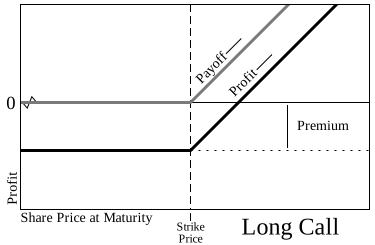
Put-call parity is a no-arbitrage identity, not a model: $C - P = S - K e^{-rT}$ for European options on a non-dividend-paying stock. It holds independent of any pricing model because both sides describe portfolios with identical payoffs at maturity. Given any five of $\{C, P, S, K, e^{-rT}\}$, the sixth is pinned down by algebra.
✓ Intro · expand
More examples
A handful of harder problems on the same theme. Click any prompt to reveal the solution sketch.
For European options on a non-dividend stock, the put-call parity reads $c + K e^{-r\tau} = p + S$, where $c$ and $p$ are the European call and put prices struck at $K$, $S$ is the current spot, $\tau$ is time to expiry, and $r$ is the risk-free rate. Prove this from a no-arbitrage argument.
Construct two portfolios at time $t$. Portfolio A: one European call + cash $K e^{-r\tau}$. Portfolio B: one European put + one share. At expiry $T$ both have payoff $\max(S_T, K)$: A pays $\max(S_T - K, 0) + K$, B pays $\max(K - S_T, 0) + S_T$. Since both terminal payoffs are identical and the underlying is non-dividend (so holding the share has no interim cashflow), no-arbitrage forces equal time-$t$ value: $c + K e^{-r\tau} = p + S$.
+ More examples · expand