User:Skbkekas, CC BY 3.0 · CC-BY-3.0 · Wikimedia Commons
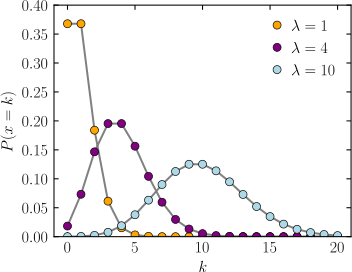
When you have many trials with small per-trial probability — defects in a production batch, complaints from a customer base, calls in a call centre — the binomial $\mathrm{Bin}(n, p)$ is well-approximated by $\mathrm{Pois}(\lambda)$ with $\lambda = np$. The Poisson PMF $e^{-\lambda}\lambda^k/k!$ is mental-math friendly for small $k$, especially once you memorize $1/e \approx 0.368$. Most “at least one,” “at least three,” or “exactly $k$” rare-event questions reduce to a 30-second lookup.
✓ Intro · expand
Try first (productive failure)
Before the worked example: spend 60 seconds taking your best shot at this.
A guess is fine — being briefly wrong about a problem makes the explanation
land harder when you read it. This appears once per tutorial; skip
if you already know the trick.
60s
✓ Try first · expand
Worked example
Six fair dice are rolled. What is the approximate probability of getting at least three sixes? Use the Poisson approximation. (2 d.p.)
✓ Worked example · expand
Practice 1 of 3Type a fraction, decimal, or expression.
✓ Practice · expand
Reflection
When does the Poisson approximation break down — what assumptions are you leaning on, and what happens when $p$ isn’t small or $n$ isn’t large? Also: Poisson has the unusual property that $\mathrm{mean} = \mathrm{variance}$. What does that tell you about the spread of rare events compared to, say, the Normal distribution?