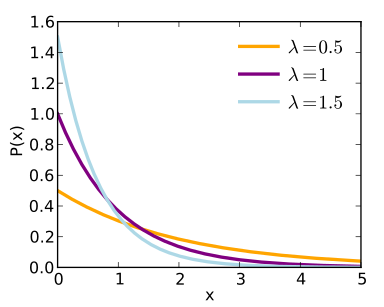
Exponential: time between Poisson events; memoryless
Time between independent events arriving at a constant rate. The continuous memoryless distribution; gaps between Poisson arrivals.
Method · Exponential
Intro
Skbkekas, public domain — Wikipedia Exponential distribution article · Public Domain · Wikimedia Commons
How long do you wait for the next bus, or the next phone call to a help desk? If those events happen at a steady average rate, the gap between consecutive events follows an Exponential distribution — the simplest model of waiting time. (For the connection-minded: it's the continuous cousin of the Geometric, and stacking k of them gives the Gamma.)
✓ Intro · expand
Try first (productive failure)
Before the worked example: spend 60 seconds taking your best shot at this.
A guess is fine — being briefly wrong about a problem makes the explanation
land harder when you read it. This appears once per tutorial; skip
if you already know the trick.
60s
✓ Try first · expand
Worked example
Calls arrive at a help desk according to a Poisson process at rate λ = 0.5 per minute. Let T = time in minutes until the next call. (a) Identify the distribution of T. (b) Compute E[T], Var(T). (c) Compute P(T > 3). (d) Given T > 2, find P(T > 5).
✓ Worked example · expand
Practice 1 of 3Type a fraction, decimal, or expression.
✓ Practice · expand
Reflection
Where does this distribution sit in the story chain — what question does it answer that the previous distribution couldn't? Try to recall the key moment formulas (mean, variance) without looking them up.