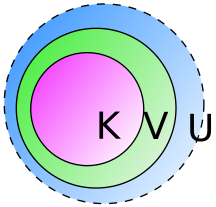
Conditional probability: shrinking the sample space
Conditioning on B is not multiplication — it's a brand-new sample space. Get that mental move right and 80% of brain teasers fall over.
Method · Conditional Probability
Intro
Oleg Alexandrov — public domain · Public Domain · Wikimedia Commons
When events depend on each other, conditional probability says: forget the original sample space, work in the world where the conditioning event has already happened. The multiplication rule $P(A \cap B) = P(A) \cdot P(B \mid A)$ chains this through any sequence of dependent events — the key is that every factor lives in a different world.
✓ Intro · expand
Try first (productive failure)
Before the worked example: spend 60 seconds taking your best shot at this.
A guess is fine — being briefly wrong about a problem makes the explanation
land harder when you read it. This appears once per tutorial; skip
if you already know the trick.
60s
✓ Try first · expand
Worked example
A bag contains 3 red and 5 blue marbles. You draw 2 marbles without replacement. What is the probability that both are red?
✓ Worked example · expand
Practice 1 of 3Type a fraction, decimal, or expression.
✓ Practice · expand
Reflection
In your own words, why does the multiplication rule need the “given” bar? What changes between $P(B)$ and $P(B \mid A)$ when you draw without replacement?