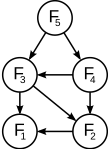
User:Dcoatzee, traced by User:Stannered · Public Domain · Wikimedia Commons
When the game has a finite end, don’t plan forward. Start from the END — where the answer is obvious — and walk backwards. At each state ask: “can I move to a state my opponent loses from?” If yes, I win. We’ll show this on a 10-match game.
✓ Intro · expand
Try first (productive failure)
Before the worked example: spend 60 seconds taking your best shot at this.
A guess is fine — being briefly wrong about a problem makes the explanation
land harder when you read it. This appears once per tutorial; skip
if you already know the trick.
60s
✓ Try first · expand
Worked example
Two players sit across from a table with 10 matches. Players alternate turns; on each turn a player must take 1, 2, or 3 matches. The player who takes the last match wins. You go first. With optimal play, do you win? Answer 1 for yes, 0 for no.
✓ Worked example · expand
Practice 1 of 3Type a fraction, decimal, or expression.
✓ Practice · expand
Reflection
What tells you to reach for backwards induction rather than first-step analysis or a direct threshold rule? And in your own words, why does anchoring at the <em>terminal</em> state — rather than the starting state — make the recursion well-defined instead of circular?